By isabelle
We're surely not telling you anything if we say that the mountains are as beautiful as they can be dangerous... Avalanches are an ever-present threat in the mountains. To ensure your safety and that of others, it's vital to know how to assess the risks and adapt your outing and your behaviour accordingly.
Avalanche risks and their assessment are intrinsically linked to three main factors :
- Conditions → The level of snow-meteorological danger
- Terrain → The gradient, orientation and frequency of use of the slopes
- People → The experience , size and organisation of your group.
Here are the key parameters to take into account when preparing your next mountain outing, from the three factors above to the concrete steps to take on the ground!
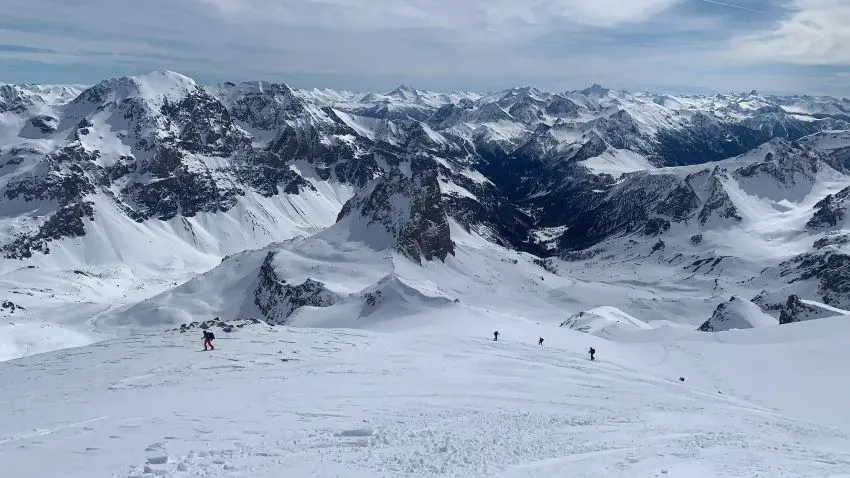
How an avalanche forms
The snowpack isn't a single uniform block. It's a stack of layers, each one laid down during a different weather episode (snowfall, thaw, wind, frost), and they don't always bond well with each other.
The problem comes from weak layers: a layer of snow transformed into large angular grains, or a thin crust of surface hoar buried under a more recent snowfall, that can't hold the load above it. When a cohesive layer (a "slab") sits on top of a weak layer, the weight of a single skier can sometimes be enough to break it, triggering a slab avalanche, the deadliest type for off-piste and ski touring practitioners. It's different from a loose-snow avalanche, which slides more gradually without forming a cohesive slab.
None of this is visible from the surface: a slope can look perfectly stable while hiding a weak layer buried 30 cm below. That's why the BERA bulletin, reading the terrain and proper training matter more than what a slope looks like.
The conditions
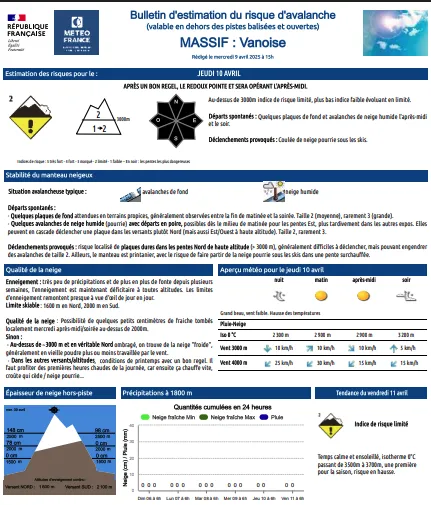
The BERA (Bulletin d'Estimation du Risque d'Avalanche) is a key resource. It provides information on current conditions in the mountains and forms the basis of any avalanche risk assessment. The risk levels (1-5), established on the basis of a number of meteorological and snow criteria, give an initial idea of the potential dangers.
- Low : Avalanche may only be triggered in the event of severe overload.
- Limited : Avalanches may be triggered especially in the event of heavy overload or on certain slopes.
- Marked : Avalanche triggering possible on many sufficiently steep slopes and sometimes even in the event of low overload.
- Strong : Avalanches are likely to trigger on most slopes and even in the event of low overload.
- Very strong : Numerous spontaneous large avalanches to be expected, even on shallow slopes.
Before every mountain outing, be sure to consult this bulletin to check the safety of your itinerary. From December to April, the BERA is published daily at 4pm and is valid for 24 hours. You can find it on the Météo France website , where bulletins are published for each region.
The gradient
97% of accidents occur on slopes of more than 30° .
It is essential to find out in advance about the gradient of the slopes you will be tackling during your outing. This information is easily accessible from applications such as Bergfex , Iphigénie , or SwissTopo (free application for Switzerland). You can also consult a map of slopes directly from the Géoportail . Based on the IGN model, this map classifies slopes into four categories according to their gradient, making it easy to read the gradient.
Orientation
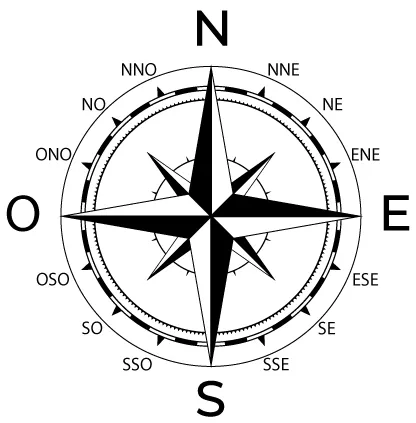
Nearly 60% of accidents occur in the north sector alone (NW to NE).
In this zone, the presence of fragile layers in the snowpack is greater, increasing the potential risk of accidents. What's more, on slopes in the shade, the snow transforms less quickly than on those exposed to the sun, so these shaded slopes are more likely to remain 'avalanchey' for longer. Before your outing, it's essential to check the orientation of the slopes you plan to use. You can find this information on the same applications used for slope inclination.
Sources: SLF (the Swiss federal institute for snow and avalanche research) and ANENA (France's national avalanche and snow research association).
Taking these parameters into account will enable you to assess the avalanche risk more carefully and plan or adapt your route accordingly.
The human factor
Conditions and terrain are objective, you can measure them. The human factor is the hardest to correct, because it's about how your group actually makes decisions.
Swiss guide Werner Munter formalised the 3x3 method, a framework still taught today in mountain guide training: it crosses three factors (conditions, terrain, human) with three decision stages, regional planning before you leave, choosing your route once on site, then a slope-by-slope decision throughout the outing. The point isn't a magic formula, it's forcing a check at every stage instead of just once in the morning.
American psychologist Ian McCammon studied more than 700 accidents involving groups led by experienced people. He identified several "heuristic traps", unconscious mental shortcuts that push people towards riskier decisions without realising it: familiarity (you let your guard down on terrain you know well), social acceptance (you don't dare be the one who suggests turning back) and the expert halo (you follow the most experienced person in the group without questioning their call).
In practice, that translates into simple rules: keep the group small, brief everyone before setting off on the route and the turnaround points, and above all, give every member of the group the right to say stop, including the guide. It's part of why our ski touring groups stay deliberately small.
Whatever happens, remember that
"When in doubt, there is no doubt. The most important skill in the mountains is to give up ".
In the mountains, caution is an important quality. If you have the slightest doubt about the safety of your outing, it's best to turn back. The mountains are certainly a playground, but a demanding one that is rarely forgiving. Anticipating, using common sense and knowing how to adapt, or even give up, are the keys to continuing to enjoy it for as long as possible!
Find out more about avalanche risks: From theory ...
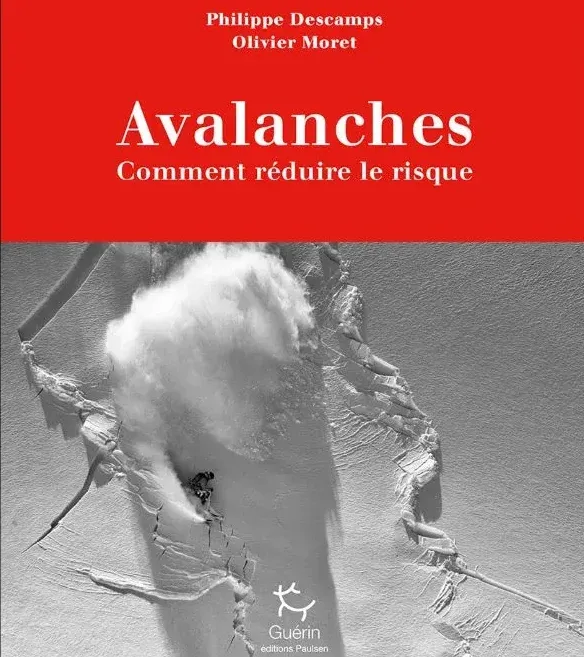
If you want to find out more about the subject, we highly recommend this book, in which the authors propose an accessible method for assessing avalanche risk. It also lists a number of simple tools for making appropriate decisions and preventing dangerous situations.
"Avalanches: How to reduce the risk" - Olivier Moret and Philippe Descamps
This lecture , presented by the two authors along with Jean-Sébastien Knoertzer and Alexis Mallon from ENSA (École Nationale de Ski et d'Alpinisme), will give you a taste of the main concepts and approaches discussed in the book.
Reducing avalanche risk in practice
Here are a few good practices for any outing on avalanche-prone terrain:
Get the right gear
Always carry a transceiver, shovel and probe, and check that they're working before you set off. Optional extras: an airbag pack, a GPS receiver.
Practise your rescue skills
Learning to use your avalanche transceiver, and to probe and shovel efficiently, is essential. Courses exist and are highly recommended, such as those run by our mountain guides.
Adopt the right behaviour
- Keep a safe distance from each other
- Cross risky sections one person at a time
- Constantly watch for signs of instability (cracks, "whumpfs", recent avalanches)
Frequently asked questions
Is a transceiver enough to protect you?
No. A transceiver, shovel and probe don't reduce the risk of an avalanche being triggered at all, they only help find and dig someone out quickly if an accident happens anyway. The real protection happens beforehand: reading the BERA, choosing the right terrain, and how the group behaves.
At what BERA risk level should you turn back?
There's no universal threshold, it depends on the terrain you're considering. But one figure is worth knowing: in France, more than half of fatal avalanche accidents happen at risk level 3 "Marked", and nearly 85% at level 3 or 4. Level 3 sounds like a reassuring middle ground, which is exactly why it's the most dangerous in practice.
Does an airbag pack replace a transceiver?
No, the two are complementary. The airbag increases your chances of staying near the surface during the avalanche, the same physical principle that makes larger objects rise in a shaken mixture, the transceiver then helps locate you quickly if you're buried anyway.
Can you go off-piste or ski touring without any training?
Technically yes, but it's not a good idea. Learning to read a BERA bulletin, use your transceiver under pressure and read the snowpack takes guided practice. That's exactly what our introductory ski touring trips with a UIAGM guide are for.
Source: French avalanche accident statistics, SLF.
Explore the mountains safely with Wildhartt
Want to enhance your theoretical knowledge with some practical learning ? We've got just what you need!
Our introductory ski touring trip is four days of full immersion around the Grand-Saint-Bernard pass, the perfect opportunity to learn how to handle the equipment and get comfortable with safety practices in the high mountains, alongside an experienced UIAGM mountain guide.
Prefer different dates or a different destination? Check out our other ski touring adventures here, there's bound to be one to suit you!
 Find your dream adventure