Migratory birds: where and when to watch them in spring
 By Marie
Watch migratory birds this spring: a month-by-month calendar, six spots in France and Belgium, and simple rules to avoid disturbing them.
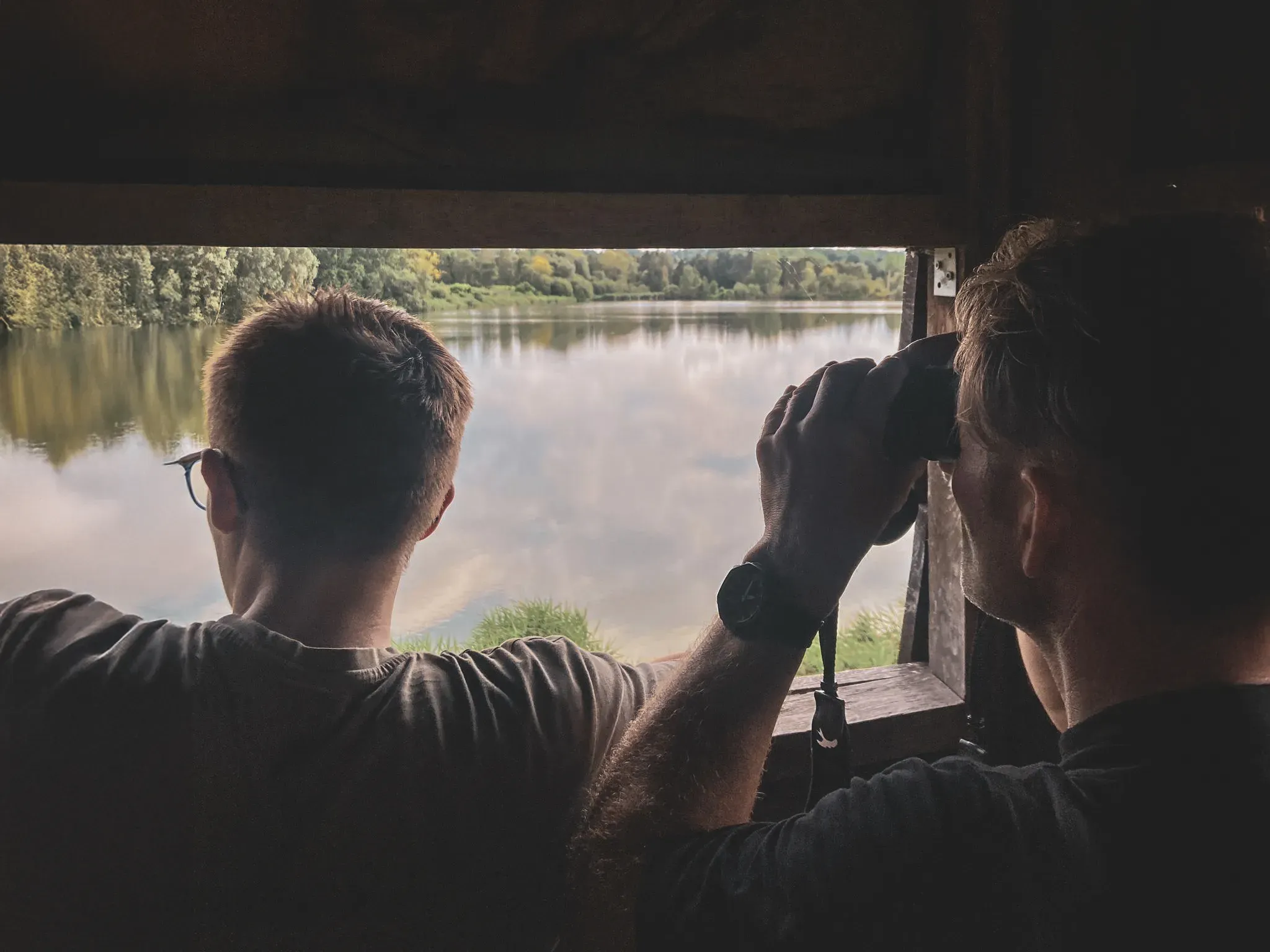
Migratory birds come back over France and Belgium by the million every spring, and most of the time all you need to watch them is a pair of binoculars, an early alarm and the right spot. Between late February and late May, cranes head north, swallows return to the farms and swifts take back the sky over town. Below: a month-by-month calendar, six real spots on both sides of the border, and the few rules that let you watch without disturbing anything.
Contents
- Why birds migrate in spring
- The spring migration calendar, month by month
- Five species that are easy to recognise as a beginner
- Where to watch migratory birds in France
- Where to see them in Belgium
- Kit, timing, weather and apps
- Watching without disturbing
- Going with a naturalist guide
Why birds migrate in spring
Birds migrate to eat, first and foremost. The LPO, France's bird protection league, puts it plainly: it isn't necessarily the cold that triggers departure, but the drop in food supply (LPO). In spring the flow reverses: insects return to Europe, days get longer, and species that wintered in Africa fly back north to breed.
The scale is hard to picture. According to BirdLife International, more than two billion migratory birds use the African-Eurasian flyway, the one passing right over our heads (BirdLife). Much of that traffic slips past you, though: nearly two thirds of European species migrate at night, says the LPO. By day you'll mostly see the big soaring birds (cranes, storks, raptors) and birds that hunt on the wing, like swallows.
Why start in spring rather than autumn? Birds wear their breeding plumage, they sing, and arrivals spread over three months that are easy to follow. You can watch one species after another come back, week after week, without knowing a thing to begin with.
The spring migration calendar, month by month
One rule of thumb: the big birds open the season in late February, insect-eaters arrive in April, swifts close it in May. The dates below are a guide only, they shift with latitude and each year's weather.
| Month | Who arrives or passes through | Where to look |
|---|---|---|
| February | Common crane (heading north), white storks returning to their nests | Large lakes in Champagne, open fields, stork nests on roofs and poles |
| March | Last cranes, first barn swallows in the south, cuckoo from mid-March | Wetlands, villages, farms |
| April | Bulk of the barn swallow arrivals, cuckoo, common swift passage | Farms, ponds, the coast, river valleys |
| May | Swifts settling in, waders stopping over, avocets and spoonbills on the coast | Channel and North Sea coasts, town centres for swifts |
Sources: LPO species pages (barn swallow, cuckoo, common swift, white stork) and LPO Champagne-Ardenne for the common crane.
Five species that are easy to recognise as a beginner
Common crane
This is often the bird that hooks beginners. You hear it before you see it: a hoarse, trumpeting call that carries a long way. Cranes fly in long lines or V shapes, necks stretched out and legs trailing behind the tail. At Lac du Der, LPO Champagne-Ardenne counts between 200,000 and 350,000 cranes stopping over every year. In spring, the return north happens mainly in late February and early March.

Photo: Unsplash
White stork
Tall, white, black-edged wings, red bill and legs: you can't mistake it. According to the LPO, it returns to its nest from February, and French storks are becoming more and more sedentary, with some now staying put all winter. It's the perfect species for seeing how a migratory bird can change its habits within a few decades.

Photo: Unsplash
Barn swallow
Brick-red throat, long forked tail, skimming low over water and meadows. The LPO records the first ones from late February in the south, but most arrive in April. Look for it around farms and open cowsheds, where it builds its mud nest.

Photo: Unsplash
Cuckoo
You probably won't see it, but you'll hear it. Its two-note call is perhaps the best-known sound of spring in Europe. It arrives from mid-March, more often in early April, according to the LPO. The day you hear it for the first time this year, write the date down: you've just started your own migration notebook.
Common swift
Sickle-shaped silhouette, piercing screams above the rooftops, it almost never lands. Its spring migration happens in April and it settles in during May. At the Zwin, on the Belgian coast, more than 1,000 swifts were counted in a single day on 26 April 2025.
Where to watch migratory birds in France
Lac du Der-Chantecoq (Marne and Haute-Marne)
Crane central. The roosts are used from October to March, and 20,000 to 30,000 cranes regularly spend the winter there, according to LPO Champagne-Ardenne. In late February, the return north brings mornings when flock after flock goes over. Aim for dawn or late afternoon, when cranes leave or return to their roosts. The LPO publishes the current season's counts, which helps you pick your date.
Bay of the Somme and the Parc du Marquenterre (Somme)
200 protected hectares in the heart of the Bay of the Somme national nature reserve, with more than 300 species recorded, according to the Parc du Marquenterre. In spring, avocets, black-winged stilts and spoonbills take centre stage, along with waders on migration stopovers. One detail that matters: dogs are not allowed, even on a lead.
Pointe de Grave (Gironde)
France's reference site for spring migration. The LPO monitors migrants arriving from beyond the Sahara there, including sand martin, common swift and hobby (French Ministry for Ecological Transition). Monitoring usually runs from late March or early April to the end of May. In the 2006 season, counters logged 82,864 birds of 103 species. Before you drive out, check the latest counts on migraction.net to see whether birds are moving.
Where to see migratory birds in Belgium
The Zwin (Knokke-Heist)
Right on the Dutch border, this coastal reserve sees plenty of birds pass through in April and May. Its late-April 2025 report gives a sense of the pace: more than 250 barn swallows on 30 April, 450 redshanks and 71 spoonbills over the period. The same report notes that passage is busiest with an easterly wind. Check the forecast the night before.
Marais d'Harchies (Hainaut)
A reserve managed by Natagora, and a good gauge of the Belgian spring. In 2024, the CRIE d'Harchies log recorded the first barn swallow on 22 March, the first cuckoo on 6 April and the first swift on 21 April. In early March, great egrets were seen leaving to the north-east.
The Dyle valley, near Leuven
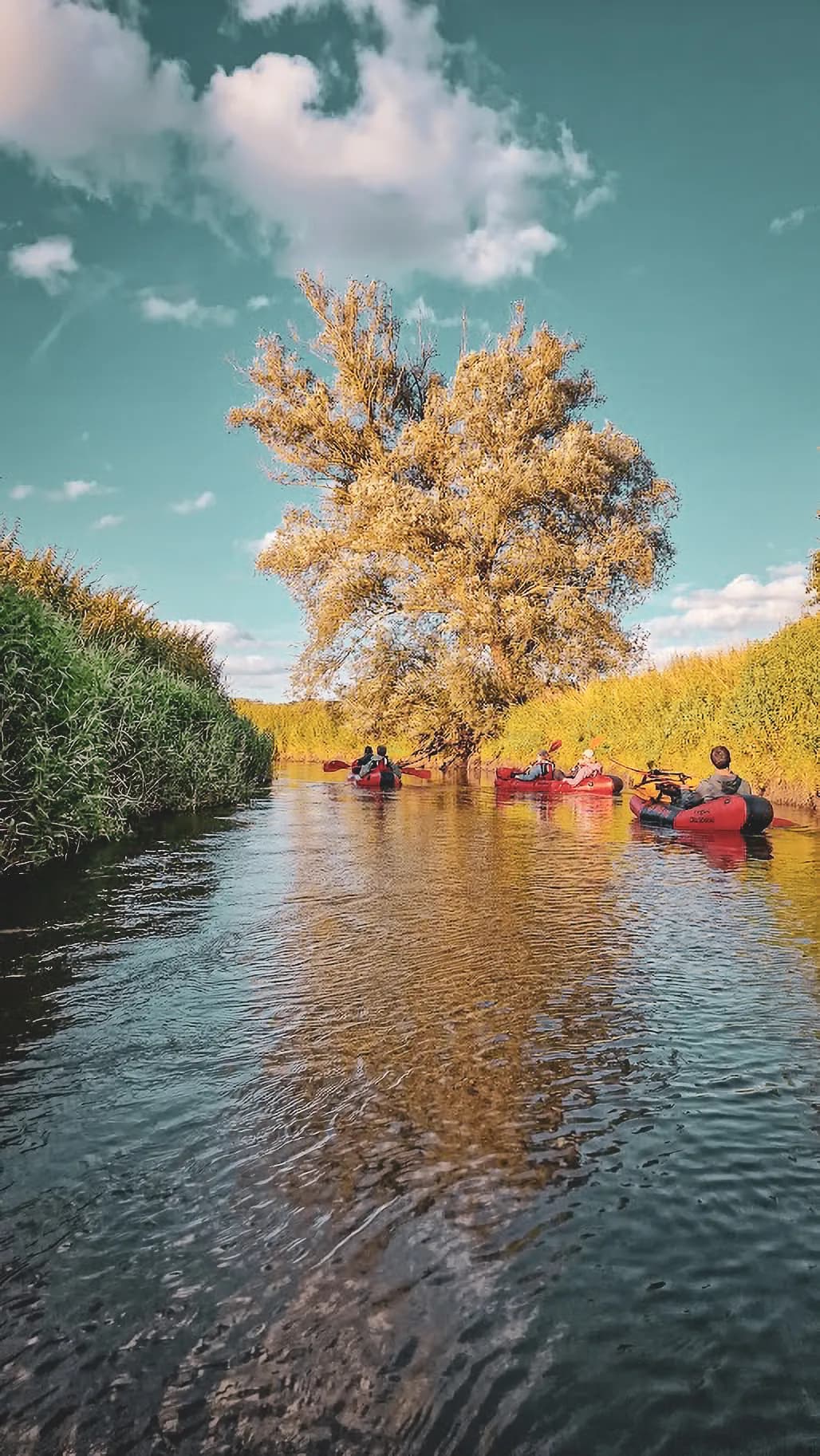
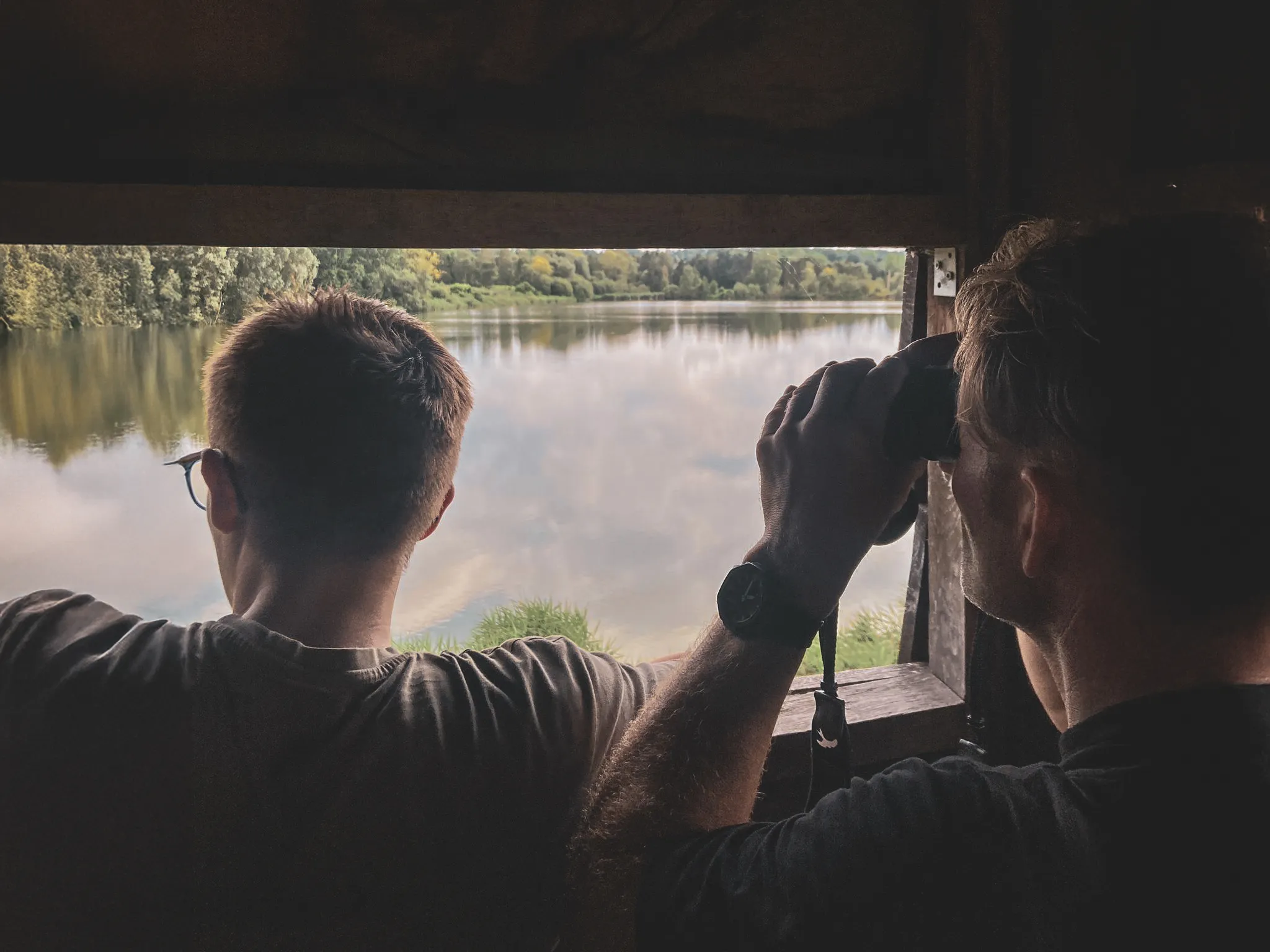
We take small groups there from April to September for a late afternoon packrafting through beaver territory, with Mathias, a biologist guide. The beaver is the star, but the valley's observation towers and the quiet paddle downstream make it good ground for birds too. Joëlle, who came with us in June 2026, summed it up better than we could: "There were also lots of birds to watch. Calm and birdsong all around."
Kit, timing, weather and apps
For a first outing you need three things: binoculars, an early alarm and a birdsong ID app. The rest comes with time in the field.
- Binoculars: any decent pair will do to start. What matters is that they're round your neck, not at the bottom of your bag, when a flock goes over.
- Timing: go early. In the morning birds sing and feed, and sites are quieter. For cranes, dawn and late afternoon are the two key moments.
- Weather: on the Belgian coast, the Zwin sees busier passage with an easterly wind. Monitoring sites publish their counts, which saves you a wasted morning.
- Merlin Bird ID: a free app from the Cornell Lab of Ornithology. You record, it suggests the species singing around you, and it covers most birds of Europe (Merlin).
- BirdNET: same idea, a joint project of the Cornell Lab and Chemnitz University of Technology, recognising over 11,000 species (BirdNET).
- migraction.net and trektellen.org: counts from monitoring sites, updated daily. Trektellen, started in the Netherlands in 2000, brings together more than 1,000 count sites, with Natuurpunt and Natagora among its Belgian partners.
A tip from the field: use the app to confirm, not to replace your ears. Listen, guess, then check. After three outings you'll know the cuckoo and the swallow without reaching for your phone.

Photo: Unsplash
Watching without disturbing
In spring, birds arrive exhausted and many start nesting straight away: that's when disturbance costs them most. France's Office for Biodiversity puts it bluntly, a frightened bird can abandon its nest (OFB). The rules fit in a few lines:
- stay on marked paths, especially in reserves;
- keep your dog on a lead, or leave it at home where the site bans dogs, as at the Marquenterre;
- be discreet and quiet, keep your voice down;
- if a bird takes off or gets agitated as you approach, you're too close, step back;
- follow the specific rules of each protected area.
That's exactly what binoculars are for: seeing up close without getting close.
Going with a naturalist guide
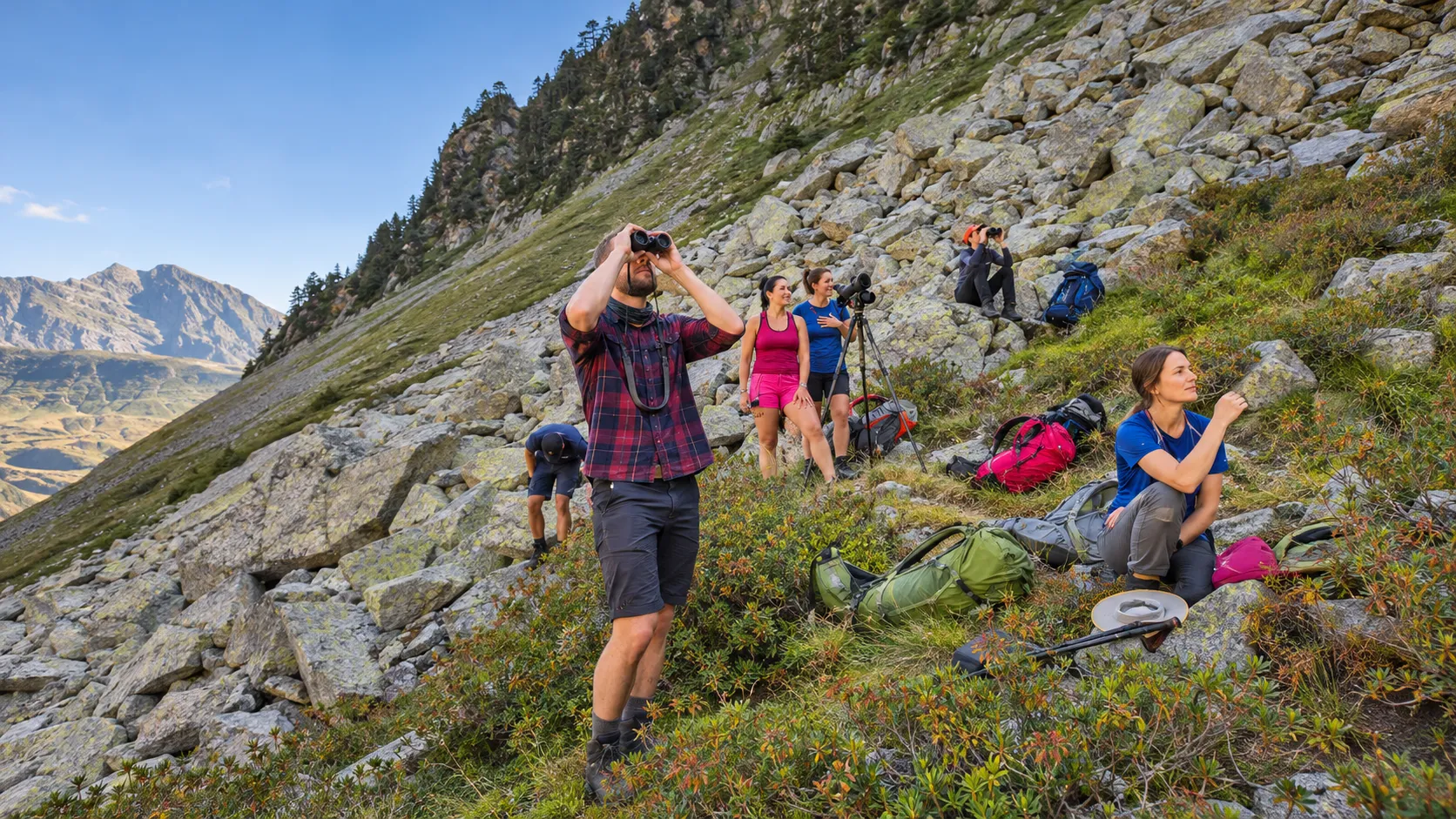
On your own, you'll see birds. With someone who can read the landscape, you'll understand what you're looking at. That's Hadrien's job, a mountain leader with a passion for wildlife and photography, on our hiking and wildlife watching trip in the Pyrenees: four days between Lac d'Ilhéou and Lac de Gaube, binoculars brought by the guide, watching for raptors over the summer pastures and dippers along the mountain streams. The trip runs from June to September, after the main spring passage, but you learn exactly what you'll need the following spring: picking out a silhouette through binoculars and understanding how a species behaves.
For Belgium, our piece on where to spot wildlife in the Hautes Fagnes and the Semois valley pairs well with this one. And all our nature trips are gathered in our wildlife and wild nature trips.
The easiest way to start? Block out the first weekend of April, pick the spot closest to home, and head out at dawn with binoculars. The swallows will handle the rest.

Find your next adventure
Browse curated expeditions matching the categories of this article and start planning your next trip.
Find your dream adventure
 Find your dream adventure
You might also like these adventures …
Hand-picked to echo the spirit of this article.