Where to start ice climbing in the French and Italian Alps
 By isabelle
An ice tower for €55, a natural practice icefall or an ice park: 7 places to start ice climbing, with access, season and prices. Pick yours.
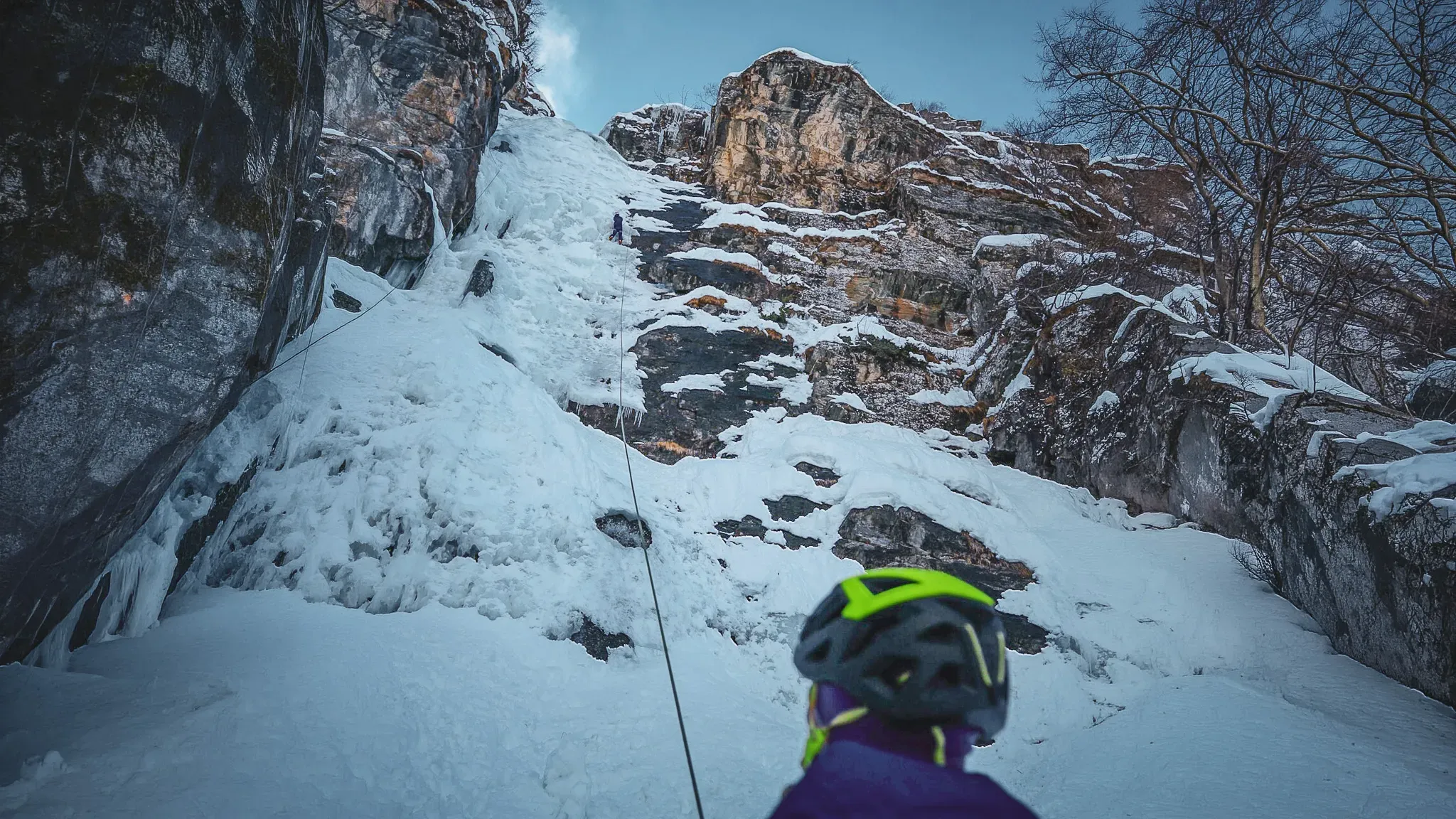
To start ice climbing, you have two ways in. The first is an artificial ice tower: two hours in the evening, gear lent, for around fifty euros. The second is a natural practice icefall, with a guide, on ice that is not too steep. In France, the easiest places to begin are Freissinières and the Fournel valley in the Écrins, Champagny-le-Haut in the Vanoise, Ceillac in the Queyras, the Oisans, and Argentière in the Chamonix valley. On the Italian side, Cogne and the Val Pellice.
For each place, we pulled together what really matters when you have never held an ice axe: the type of ice, the approach walk, the season, and the introduction prices listed in November 2026 by tourist offices and guiding companies.
Tower, practice icefall or natural ice: where to begin
There are three kinds of terrain, and they ask very different things of a beginner.
The ice tower. A steel and wood structure that is sprayed with water in winter until it is covered in ice. The one at Champagny-le-Haut is built with gradually increasing angles, so you step up in difficulty without nasty surprises. You climb on a top rope (the rope is anchored at the top and someone belays you from below), the gear is lent, and you park a few steps away. It still depends on the cold: sessions are announced "subject to icing".
The semi-artificial practice icefall. Water is run down a cliff so it freezes, and the local guiding office maintains it. According to Objectif Alpinisme, a small contribution of around €4 a day is sometimes asked. You will find them at Les Claux in Pelvoux-Vallouise, at the Barmette rock in Bessans, at Aiguilles in the Queyras and at Bérard near Chamonix.
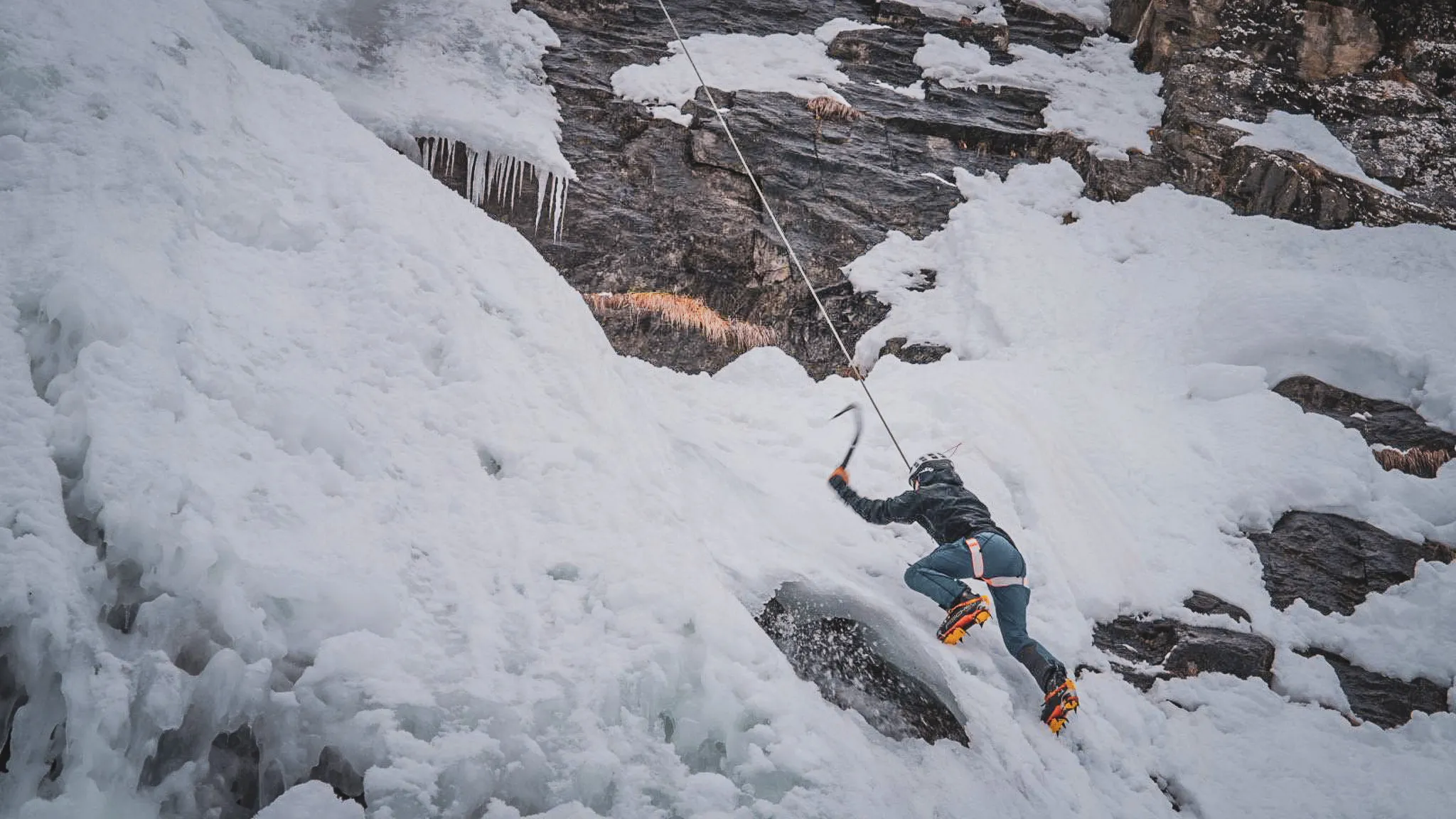
The natural icefall. This is where ice climbing really comes into its own, and where a guide becomes essential. For a first time, the same site advises aiming for grade 3 icefalls, around 75° with plenty of steps. An icefall that has not fully formed quickly becomes much harder than its grade. If the numbers and letters in a topo look cryptic, our article on ice climbing vocabulary explains how to read a grade like 3/II.

Photo: Kris Tian, Unsplash
Where to start in France
Freissinières and the Fournel (Écrins): an 18 m tower with 200 routes around it
For a very first try, Freissinières is probably the simplest option. The village has an 18-metre artificial tower, reached from the car park opposite the town hall, usually open from December to March depending on snow. Introduction sessions run in the evening, on Tuesdays and Fridays, for around €50 for an adult and €40 for a junior, according to the Pays des Écrins tourist office.
If the tower hooks you, the next step is right next door. The Pays des Écrins has more than 200 ice routes, including 120 natural lines in the Fournel valley, and the Freissinières valley is known for its short approaches. The tourist office lists five introduction icefalls to do with a guide: Fracastorus in Freissinières, Clapouse in Pelvoux, the Géant des Tempêtes in L'Argentière and Beating the Retreat in the Fournel, plus the tower. Every January, L'Argentière-La Bessée also hosts Ice Climbing Écrins, an international festival with guided days, workshops and films.
Champagny-le-Haut (Vanoise): climbing an ice tower at night
In the Champagny-le-Haut valley, a protected natural site above Champagny-en-Vanoise, an ice tower of around twenty metres hosts guided introductions. For the 2026-2027 season, the tourist office lists sessions from 12 December to 17 April, on Tuesdays and Thursdays from 6pm to 8pm, at €55 per person (€50 from 4 people), gear included. It is open from age 10. A good option if you are travelling as a family, or if you are already skiing in the Tarentaise and want to try ice one evening without giving it a whole day.
Ceillac (Queyras): the Y, a natural practice icefall
If you had to pick just one natural ice venue to start in France, it would probably be this one. Ceillac is about an hour's drive from Briançon. You park at the foot of the ski slopes, cross the bridge, and reach the icefalls in 10 to 15 minutes, often on a track that is already broken. The village describes the site as ideal for learning and improving, and says conditions are "almost guaranteed" on four of its icefalls.
The star is the Y (also called Holiday on Ice), graded II+/3+ over 250 metres and described as an ideal practice icefall. Easy Rider, II/3 over 70 metres, is the easiest on the site. The same page is honest about the limits: Easy Rider, Vermicelle and Arlésienne are exposed to avalanches, and a slide hit Sombre Héros in 2010, on a very mild day when the thermometer read +8.2°C in the afternoon. All the more reason to go with someone who can read the mountain.
Oisans: 600 icefalls, from the Col d'Ornon to La Grave
The Oisans is one of the birthplaces of the sport: pioneers were climbing here from the late 1970s, and the tourist office lists no fewer than 600 frozen waterfalls. Not all of them are for you, and that is fine. To begin, the Col d'Ornon is mentioned as popular with beginners, and the Vallon du Diable, near Saint-Christophe-en-Oisans, as suited to different levels. Above Alpe d'Huez, the cliffs by Lac Besson offer several grade 3 routes close to the ski runs, often in good condition according to Objectif Alpinisme, which also mentions a yearly introduction day at €45, gear lent, at the La Bérarde guiding office. La Grave mostly draws experienced climbers: keep it for later.
Argentière (Chamonix valley): La Crèmerie
In the Chamonix valley, Argentière has three ice venues, and one of them is made for you: La Crèmerie, at 1,350 metres, where the icefalls are low-angled and described by chamonix.net as a good way to start. From the Grands Montets car park, follow the signs for the helicopter landing zone, then the path: about twenty minutes on foot. For artificial ice, the Bérard icefall is also in the valley. Chamonix also means plenty of guides available to take you out.
On the Italian side: Cogne and the Val Pellice
Cogne (Aosta Valley): more than 150 icefalls and an ice park
At the gateway to the Gran Paradiso, the Cogne valley has more than 150 icefalls, which makes it a reference for ice climbing in Italy. For beginners, the way in is the Moline Ice Park, presented as suitable whether you are on your first ice axe or have been climbing for years, and lit in the evening. It works with the Società delle Guide Alpine di Cogne, the local guiding company. Prices are not published online: ask the guides directly.
The Val Pellice: our week at the Willy Jervis hut
This is where, in the Conca del Pra facing Monte Viso, we set up our ice climbing and ski touring introduction course. The Willy Jervis hut, at 1,738 metres, is surrounded by frozen larches and icefalls: the Pis for the first top-rope session, then the Artia d'Amunt or the Jervis icefall depending on the group's level. Marco and Jean, IFMGA guides, pick the safest option each day.
To be clear about the format: over six days, ice takes up two half-days, and the rest is ski touring, all the way to the Queyras over the Col d'Urine. So you need to be comfortable off-piste. If ice is your only goal, a tower or a dedicated course will suit you better. If you want ice at the heart of a real mountain week, in a hut, with 4 to 8 people, that is our format: €1,100, accommodation, meals and ice gear included, departures from January to March.
The 7 places at a glance
| Place | Massif | Type of ice | What helps as a beginner | Introduction (listed price) |
|---|---|---|---|---|
| Freissinières | Écrins | 18 m tower and natural icefalls | Car park opposite the town hall, evening sessions | About €50 (adult) |
| Champagny-le-Haut | Vanoise | Artificial tower | From age 10, gear included, 2 hours | €55 (€50 from 4 people) |
| Ceillac | Queyras | Natural | 10 to 15 min approach, the Y as a practice icefall | Depends on the guide |
| Oisans | Oisans | Natural, 600 icefalls | Col d'Ornon and Lac Besson to begin | €45 for La Bérarde's yearly day |
| Argentière | Mont Blanc | Natural | La Crèmerie, low angle, 20 min walk | Depends on the guide |
| Cogne | Gran Paradiso | Natural and ice park | Ice park lit in the evening | Not published |
| Val Pellice | Cottian Alps | Natural | Guided week in a hut, ice and ski touring | €1,100 all inclusive, 6 days |
When to go
Natural ice does not come to order. In the Oisans, the best period generally runs from December to February. Some icefalls need a long cold spell to form completely, others are better early in the season: in Ceillac, that is the case for Vermicelle. Artificial towers offer a longer window, from December to March in Freissinières and until mid-April in Champagny, always depending on the cold.
One piece of advice comes up with everyone who climbs: avoid weekends. Objectif Alpinisme puts it plainly, ice is getting rarer while there are more and more climbers. On a Tuesday in Ceillac, you stand a better chance of having the Y to yourself. Before you go, conditions for several venues are shared on conditions.ice-fall.com, which the village of Ceillac links to.
On your own or with a guide?
On a tower, the question does not arise: the session is supervised and the gear is lent. On a natural icefall, take a guide, at least for your first outings. Knowing whether an icefall is in condition, whether it has warmed up too much during the day, whether the slope above might slide, is not something you learn from a topo. Sombre Héros in Ceillac shows it well: one mild afternoon is enough.
It is also what participants remember from a good week on ice. Arnaud, who did our course in the Val Pellice, talks first about "a guide who knows how to adapt to the group, to the weather and to the mountain so that everyone has a great week". On ice, that is exactly the job.
For gear, hire first. Introductions provide ice axes, crampons, harness and helmet, and you will see later what suits you. Our article on ice climbing equipment covers it all, and if you are torn between a single day and a course, we have compared the formats and prices of an introduction.
Frequently asked questions
Where can a beginner go ice climbing in France?
Start with an ice tower, in Freissinières in the Écrins or Champagny-le-Haut in the Vanoise: a two-hour session, gear lent, for around €50 to €55. For a first natural icefall with a guide, the Y at Ceillac, La Crèmerie at Argentière and the Col d'Ornon in the Oisans are among the classics.
How much does an ice climbing introduction cost?
Count about €50 for a two-hour session on an ice tower, and from €145 for a guided day on a natural icefall, gear included, based on the prices we found in October 2026 in our comparison of formats.
What trousers should I wear for ice climbing?
Waterproof hardshell trousers, as for mountaineering: on an icefall you often get sprayed by melting ice or by the chips you knock off. That is what our packing list for the Val Pellice asks for, along with warm gloves and a spare pair.
From what age can you go ice climbing?
On the Champagny-le-Haut tower, introductions are open from age 10. Freissinières offers a junior rate. On a natural icefall, the guide decides depending on the child and the venue.
And if you are still weighing ice against snowshoeing or ski touring for your winter, our comparison of winter mountain activities puts them side by side. To go back to basics, getting started with ice climbing covers the where, how and when.

Find your next adventure
Browse curated expeditions matching the categories of this article and start planning your next trip.
Find your dream adventure
 Find your dream adventure
You might also like these adventures …
Hand-picked to echo the spirit of this article.